

Titanium in Implantology: A Scientific Perspective
Do you know how much titanium is consumed by implantology worldwide?
Considering that a dental implant weighs approximately between 0.2 and 0.6 grams, and that abutments and prosthetic components usually contribute similar or even greater amounts of material, industrial estimates suggest that dentistry consumes several dozen tons of medical-grade titanium every year. This is a small figure compared with sectors such as aerospace, but it represents an extremely high added value per kilogram processed.
What is interesting is that, although the volume of titanium used in implantology is relatively low, it represents one of the most sophisticated biomedical applications, with the highest requirements in terms of purity, metallurgical control, precision machining, and regulatory traceability.
The modern history of implantology is closely linked to titanium. When the Swedish researcher Per-Ingvar Brånemark observed, in the 1950s, the intimate bond between titanium and living bone, he described the phenomenon of osseointegration, which later gave rise to modern oral implantology. The first clinical studies began in the 1960s, and titanium-based implantology became established worldwide during the 1970s and 1980s.
Today, more than 90% of dental implants placed worldwide are made of titanium or titanium alloys, making this metal the most documented biomaterial in all of restorative dentistry.
The Science Behind Titanium Grades
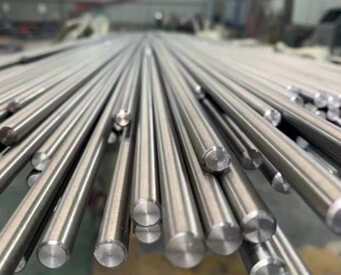
According to ASTM standards for medical applications, which describe specific procedures for evaluating material properties such as mechanical strength, chemical composition, and biocompatibility, the materials most commonly used in implantology are:
Commercially Pure Titanium Grade 4 (ASTM F67)
Titanium Grade 5 ELI / Grade 23 (ASTM F136)
Their fundamental difference is not only chemical, but also microstructural.
Grade 4 Titanium: The Biological Standard
Grade 4 belongs to the group known as Commercially Pure Titanium, or CP-Ti.
Its mechanical strength is mainly achieved through the controlled content of oxygen, nitrogen, and iron, present in very small amounts. As the oxygen content increases from Grade 1 to Grade 4, mechanical strength also increases.
Metallurgical Characteristics
- Practically pure α, or alpha, structure.
- Absence of major alloying elements.
- Excellent formation of surface TiO₂ oxide.
- High corrosion resistance.
Approximate Mechanical Properties
| Property | Grade 4 Titanium |
|---|---|
| Tensile strength | ~550 MPa |
| Yield strength | ~480 MPa |
| Elastic modulus | ~105 GPa |
| Density | 4.5 g/cm³ |
Biological Importance
The titanium surface spontaneously develops a passive titanium oxide film only a few nanometers thick, which:
- Promotes protein adsorption.
- Encourages osteoblast adhesion.
- Facilitates bone mineralization.
- Reduces electrochemical corrosion.
For this reason, Grade 4 continues to be considered by many researchers as the “gold standard” for osseointegration and, therefore, for dental implants.
Grade 5 ELI Titanium: The Mechanical Standard
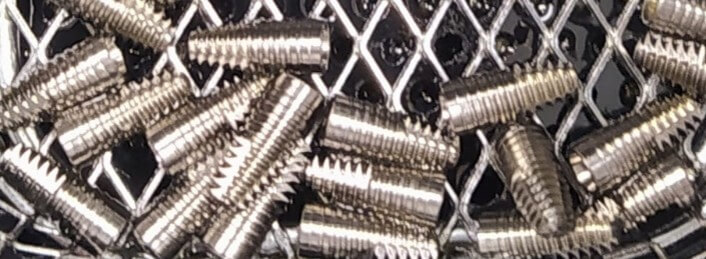
When biomechanical demands increase, the industry turns to the Ti-6Al-4V ELI alloy, and at DESS, as a manufacturer of implant attachments, we are no strangers to this approach.
The typical composition of Grade 5 titanium is usually:
- 6% aluminum
- 4% vanadium
- Balance titanium
The addition of aluminum stabilizes the α phase, while vanadium stabilizes the β phase, creating an α+β alloy with far superior mechanical properties.
Mechanical Properties
| Property | Grade 5 ELI Titanium |
|---|---|
| Tensile strength | 900–1000 MPa |
| Yield strength | 800–900 MPa |
| Elastic modulus | 110–115 GPa |
| Hardness | ~349 HV |
| Fatigue resistance | Very high |
In practical terms, Grade 5 ELI is approximately 60% to 80% stronger than Grade 4.
Why Use Grade 4 in the Implant and Grade 5 in the Attachment?
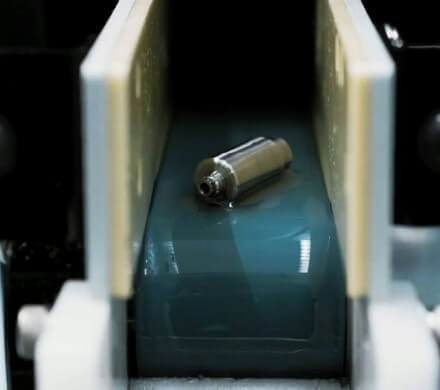
Because each component has a different biomechanical function.
The Implant
The implant body must:
- Integrate with the bone.
- Distribute loads.
- Maintain biological stability for decades.
The priority is biocompatibility and osseointegration. For this reason, Grade 4 remains the clinical reference.
The Prosthetic Attachment
Abutments such as Ti-Bases, Multi-Units, and other transepithelial components must withstand:
- Millions of masticatory cycles.
- High stress concentrations.
- Micromovements in the connection.
- Eccentric and parafunctional forces.
This is why the priority here is fatigue resistance, and in this respect Grade 5 ELI is clearly superior.
Various studies show that mechanical failures in implantology most often occur in elements such as the screw, the connection, or the Ti-Base, rather than in the implant itself. For this reason, modern engineering concentrates the highest-strength material precisely in the prosthetic components.
The Role of DESS in the Use of Titanium
DESS Dental Smart Solutions has based much of its technological development on this philosophy of material selection.
Its prosthetic attachment solutions are usually manufactured using Grade 5 ELI titanium (ASTM F136), taking advantage of the key benefits offered by this titanium grade:
- Greater fatigue resistance.
- Greater machining precision.
- Less deformation of the connection.
- Better performance under repeated loads.
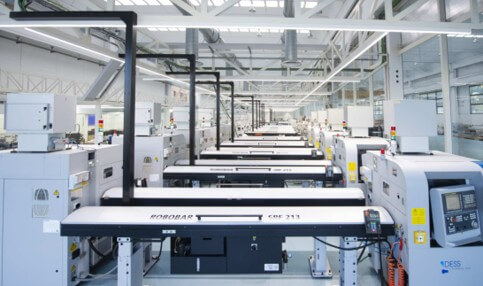
In addition, technologies such as SelectGrip® seek to optimize the interaction between titanium surfaces and modern restorative materials, especially in digital CAD/CAM workflows.
From a biomedical engineering perspective, DESS’s strategy is consistent with the principle of material functionalization:
- Grade 4 where biology is needed.
- Grade 5 ELI where mechanics are needed.
For this reason, the three implant systems manufactured by DESS — Active HEX, Conical BLT, and the new equivalent to the NEODENT GM system — are manufactured with Grade 4 titanium.
Conclusion
Modern implantology does not use different titanium grades by chance. It uses each material where its properties are most advantageous:
- Grade 4 Titanium → maximum osseointegration, biocompatibility, and biological stability.
- Grade 5 ELI Titanium → maximum mechanical strength, fatigue resistance, and prosthetic precision.
This combination has been clinically proven for more than four decades to be one of the most reliable solutions in all of implantable medicine, and it constitutes the technological foundation on which specialized manufacturers such as DESS develop their high-precision prosthetic components.



David Cuervo ist ein Spezialist für Zahnprothetik bei DESS Dental, als Teil unserer Abteilung für technischen Support sind er und Oriol für die Kundenbetreuung zuständig.
-
Titanium in Implantology: A Scientific Perspective
September 15, 2026
-
Scan Bodies for Dental Implants: Common Errors That Affect Restoration Accuracy
 August 28, 2026
 -
Peri-Implant Soft Tissue and the Long-Term Success of Implant-Supported Restorations
August 21, 2026
-
Transepithelial abutments: DESS® solutions for screw-retained implant restorations
 July 29, 2026
 -
KOL Interview: Digital Workflows, Precision & Predictable Implant Restorations
 July 28, 2026