

Peri-Implant Soft Tissue and the Long-Term Success of Implant-Supported Restorations
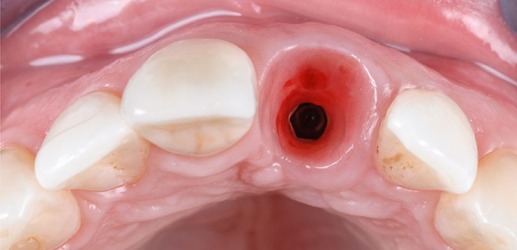
Source: Adapted from Gomez-Meda et al., 2021.
Introduction
For many years, modern implant dentistry has focused much of its efforts on osseointegration and the maintenance of marginal bone levels. However, recent scientific evidence has highlighted that the stability of soft tissue around dental implants plays an equally important role in peri-implant health, esthetic stability, and the longevity of implant-supported restorations.
This growing interest in peri-implant tissues is based on their function as a biological interface between the oral environment and the implant supporting structures. Factors such as mucosal thickness, keratinized mucosa width, and the proper configuration of transmucosal components can directly influence peri-implant tissue stability and the maintenance of long-term outcomes.
Biological Aspects of Peri-Implant Soft Tissues
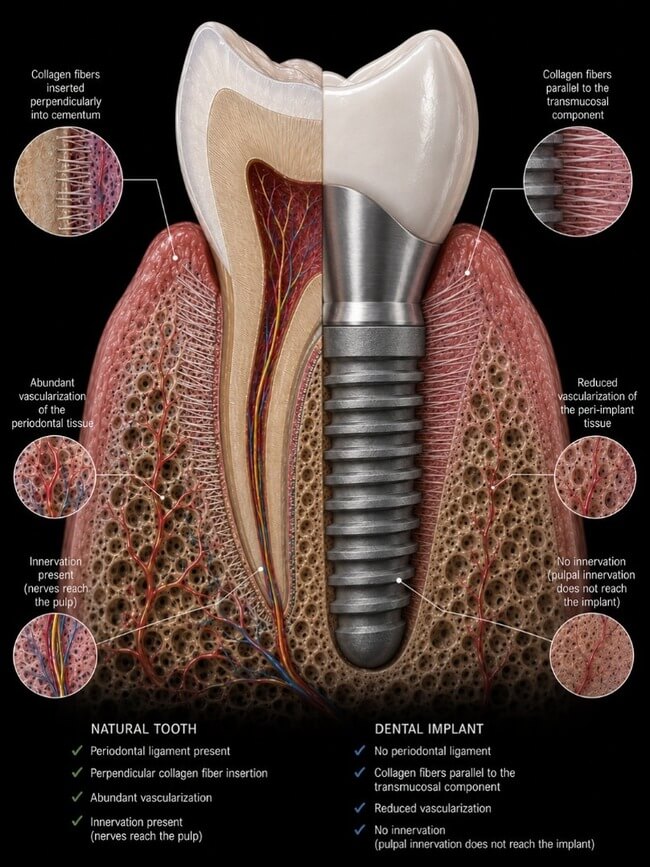
Unlike the periodontal tissues surrounding natural teeth, peri-implant tissues exhibit distinct histological and biological characteristics.
While the collagen fibers of the connective tissue insert perpendicularly into the root cementum around natural teeth, these fibers are predominantly arranged parallel to the surface of the transmucosal component around implants. In addition, peri-implant connective tissue exhibits a lower degree of vascularization compared with periodontal tissue.
These biological differences result in a reduced capacity to withstand bacterial and mechanical challenges, making peri-implant soft tissues particularly susceptible to the biological challenges surrounding the implant.
For this reason, contemporary implant dentistry has increasingly focused on the concept of the peri-implant phenotype, defined as the set of anatomical and tissue characteristics surrounding the implant that influence the long-term behavior of peri-implant tissues.
Peri-Implant Phenotype and Tissue Stability
Recent evidence suggests that a thin peri-implant phenotype is associated with reduced soft tissue stability, a higher incidence of mucosal recession, and increased susceptibility to marginal bone loss.
Currently, there is broad consensus regarding the importance of three key parameters:
Mucosal Thickness
Several studies have demonstrated that a mucosal thickness ≥2 mm promotes peri-implant tissue stability and is associated with reduced crestal bone changes following implant placement.
Keratinized Mucosa Around Implants
The presence of at least 2 mm of keratinized mucosa has been associated with improved clinical parameters, lower plaque and bleeding indices, and a reduced prevalence of peri-implant diseases.
Supracrestal Tissue Height
The proper establishment of the peri-implant supracrestal tissue complex remains one of the most important factors for maintaining long-term peri-implant tissue stability.
Transmucosal Abutments and Peri-Implant Tissue Stability
As our understanding of peri-implant tissue behavior continues to evolve, it has become increasingly clear that the long-term success of a restoration depends not only on the implant itself. As the direct interface between the restoration and the surrounding soft tissues, transmucosal abutments and other transmucosal components play a fundamental role in the biological stability of the treatment.
Their design, height, and surface characteristics can influence peri-implant tissue stability and the maintenance of long-term outcomes.
Factors such as transmucosal height, emergence profile, material selection, and component surface characteristics may influence:
- Soft tissue stability.
- Biofilm accumulation.
- Peri-implant inflammatory response.
- Gingival margin stability.
- Crestal bone remodeling.
Implant Emergence Profile Design and the Esthetic Biological Contour Concept
One concept that has significantly influenced the design of implant-supported restorations over the last decade is the management of the implant emergence profile.
The critical contour, located in the most coronal portion of the emergence profile, plays a decisive role in determining the final position of the soft tissues. In contrast, the subcritical contour provides support for the surrounding tissues and allows modulation of their volume throughout the different phases of treatment.
More recently, these concepts have evolved into broader biologically driven approaches such as the Esthetic Biological Contour (EBC), which divides the transmucosal profile into distinct functional areas. Within this model, the Esthetic Zone contributes to shaping the visible soft tissues, the Bounded Zone supports the establishment and maintenance of the peri-implant mucosal seal, and the Crestal Zone is associated with the stability of the supporting tissues and the maintenance of marginal bone levels.
Proper management of these areas during the provisionalization phase facilitates the transfer of the peri-implant architecture to the definitive restoration.
At this stage, restorative dentistry, periodontics, and prosthodontics cease to function as separate disciplines and become part of a single biological and restorative strategy.
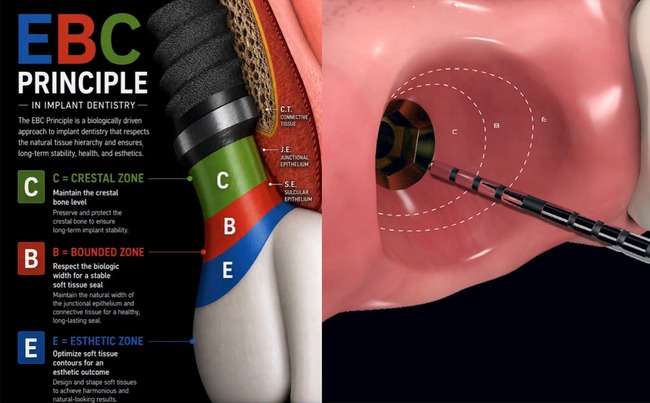
Source: Adapted from Gomez-Meda et al., 2021.
Digital Workflows and Peri-Implant Tissue Preservation
The introduction of digital workflows has significantly changed the management of peri-implant tissues.
The ability to capture individualized emergence profiles using intraoral scanners and transfer this information to the laboratory allows for a more accurate reproduction of the tissue architecture developed during provisionalization.
As a result, components such as scan bodies, CAD libraries, and CAD/CAM solutions have become essential tools for preserving the biological information obtained clinically.
DESS® Solutions for Peri-Implant Tissue Stability
Within this new treatment philosophy, prosthetic components are no longer considered simple mechanical elements but rather tools designed to preserve and manage peri-implant tissues.
In this context, DESS® offers solutions designed to integrate seamlessly into every stage of the restorative workflow:
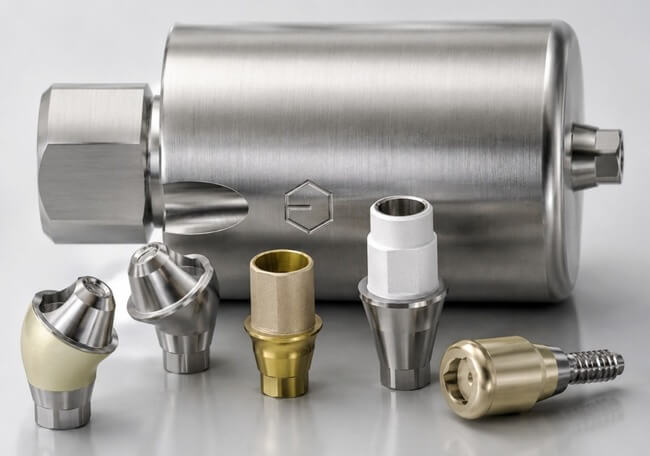
- Components featuring patented Periocoat® technology, a Zirconium Nitride (ZrN)-based coating applied to different solutions within the DESS® portfolio, designed to optimize surface properties and promote reduced bacterial adhesion.
- Anatomical Multi-Unit Abutments, designed to support a more physiological transmucosal transition.
- MUA+, developed from the anatomical design of DESS® Multi-Unit Abutments, incorporates patented Periocoat® technology and is designed to promote a more physiological transmucosal transition while integrating the biological advantages of the coating.
- DESSLoc®, an overdenture retention system available with patented Periocoat® technology, developed to combine prosthetic functionality with peri-implant tissue maintenance in removable implant-supported rehabilitations.
- Thinner Ti-Base, a straight solution designed for narrow platforms that promotes a smoother transition between the implant diameter and the restoration profile. Its design enables the development of more natural emergence profiles and enhances the esthetic integration of the restoration with the surrounding peri-implant tissues.
- Thinner ANGLEBase®, based on the same design philosophy as the Thinner Ti-Base, promotes a progressive transition between the implant and the restoration to support more natural emergence profiles. In addition, it allows screw channel correction of up to 25° with 360° rotation, providing greater restorative flexibility.
- Pre-Milled Blanks for the CAD/CAM fabrication of customized abutments, allowing the transmucosal profile to be individualized and the emergence profile to be precisely optimized according to the biological and restorative requirements of each case.
Beyond the individual characteristics of each product, the objective is to provide clinicians with tools that integrate biology, prosthetics, and digital workflows into a single treatment strategy.
Conclusion
Implant dentistry is evolving toward an increasingly biological approach. While bone stability remains essential, recent scientific evidence confirms that the behavior of peri-implant soft tissues plays an equally decisive role in the long-term success of implant-supported rehabilitations.
For this reason, the management of peri-implant tissues should be incorporated into implant treatment planning from the earliest stages of treatment. The integration of biological, restorative, and digital principles is fundamental to promoting peri-implant tissue stability and ensuring the long-term success of implant-supported restorations.
References
1) Prosthetic design considerations to optimize peri-implant tissue healing and health - a narrative review. Jason D. Lee, Jessica Poon, Oliver Viera, Kevin Kwon, Richard Liu.
2) Peri-implant tissue stability: The PROS concept. Jonathan Misch, Abdusalam E Alrmali, Pablo Galindo-Fernandez, Muhammad H A Saleh, Hom-Lay Wang.
3) Structure, biology, and function of peri-implant soft tissues in health and disease: a comprehensive review of the literature. Néstor Ríos-Osorio, Luis Gabriel Ladino, Mario Guerrero-Torres.
4) Prospective observational cohort study of the change of the marginal bone crest in relation to the prosthetic abutment height and the peri-implant vertical mucosal thickness at implants positioned subcrestally. Serafín Maza-Solano, María Baus-Domínguez, Manuel-María Romero-Ruíz, Aida Gutiérrez-Corrales, Daniel Torres-Lagares, María-Ángeles Serrera-Figallo.
5) Long-term stability of soft tissue augmentative procedures at implant sites. Lorenzo Tavelli, Shayan Barootchi, Samuel Akhondi, Edward Shih-Chang Tseng, Francisco Salvador Garcia-Valenzuela, Istvan A Urban, Hom-Lay Wang.
6) Keratinized Mucosa Width and Incidence of Peri-Implant Diseases: A Systematic Review With Meta-Analysis. Isabella Neme Ribeiro Dos Reis, Daniel Stefan Thoma, Thaís Emília da Silva, Milena Quesada Passos, Luisa Souza Feitosa, Cláudio Mendes Pannuti, Ronald Ernest Jung, Nadja Naenni.
7) Peri-implant phenotype influences outcomes of tissue-level implants at five years. Hamoun Sabri, Parham Hazrati, Lorenzo Tavelli, Carlos Garaicoa-Pazmino, Javier Calatrava, Hom-Lay Wang, Shayan Barootchi.
8) The esthetic biological contour concept for implant restoration emergence profile design. Ramon Gomez-Meda, DDS; Jonathan Esquivel, DDS; Markus B. Blatz, DMD, PhD.


Dra. Patricia Isaac is a dentist and specialist in Oral Rehabilitation at DESS® and is part of our technical support department. She assists and supports our customers with technical issues about products, dental implants and prosthetic abutments, among others.
-
Titanium in Implantology: A Scientific Perspective
 September 15, 2026
 -
Scan Bodies for Dental Implants: Common Errors That Affect Restoration Accuracy
 August 28, 2026
 -
Peri-Implant Soft Tissue and the Long-Term Success of Implant-Supported Restorations
August 21, 2026
-
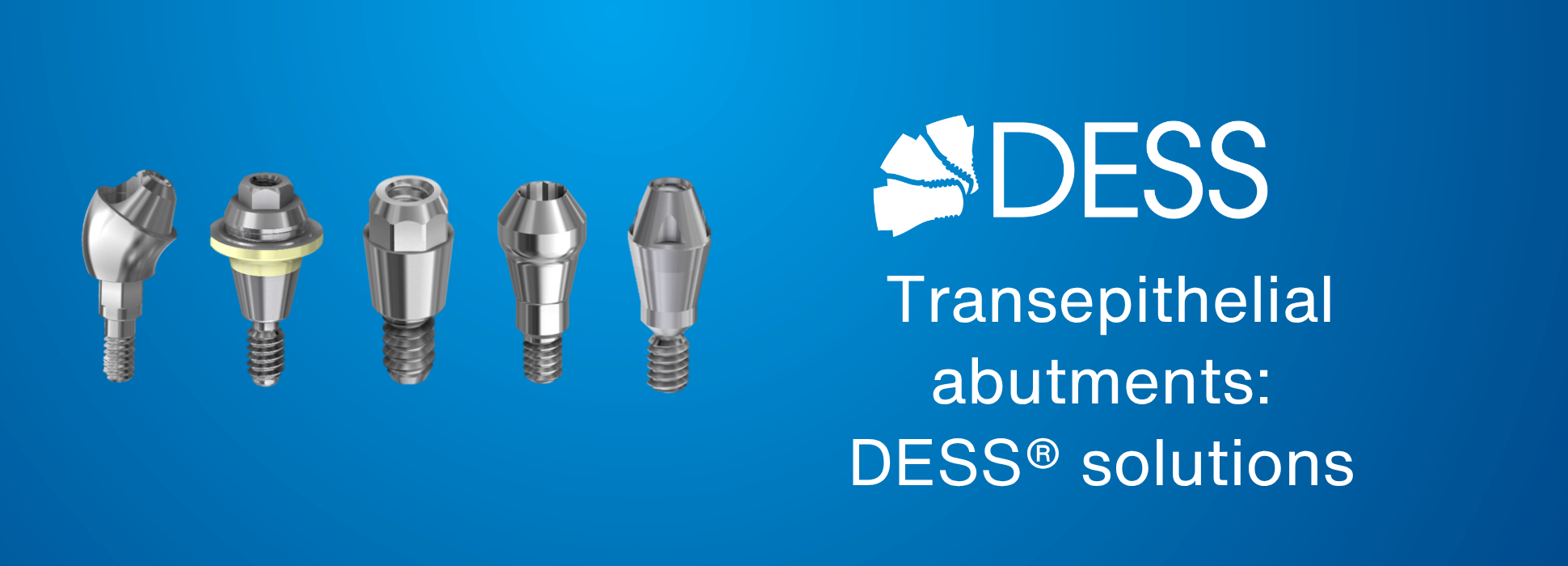
Transepithelial abutments: DESS® solutions for screw-retained implant restorations
 July 29, 2026
 -
KOL Interview: Digital Workflows, Precision & Predictable Implant Restorations
 July 28, 2026