

Healing Abutment vs Cover Screw: Key Differences in Dental Implant Treatment
When planning an implant restoration, choosing between a healing abutment and a cover screw is one of the earliest decisions that influences soft-tissue management, prosthetic timing and how cleanly the restorative phase progresses. Although both components sit at the same point in the workflow, between implant placement and definitive restoration, they serve different clinical purposes. DESS®, for example, produces both components for its Conical BLT and Active Hex implant lines and for a broad range of compatible systems.
This article compares healing abutment vs cover screw from a clinical decision-making perspective: what each component does, how they relate to one-stage and two-stage protocols, how they influence soft-tissue healing, and what clinicians should verify before placing either one.
What is a cover screw?
A cover screw is a low-profile component that seals the internal connection of the implant during a submerged healing period. Unlike a healing abutment, a dental implant cover screw does not extend through the soft tissue. Instead, the mucosa is sutured over the implant and the cover screw, allowing osseointegration to take place without transmucosal exposure.
In practical terms, an implant cover screw protects the implant connection from bone or soft-tissue ingrowth during the healing period. When the patient returns for second-stage surgery, the soft tissue is reopened, the cover screw is removed, and a healing abutment is placed to begin transmucosal healing.
What is a healing abutment?
A healing abutment, also referred to as a healing cap in some markets, is a transmucosal component that screws into the implant immediately after placement (or after second-stage uncovering) and emerges through the soft tissue. Its primary function is to shape the peri-implant soft tissue during the healing phase and to maintain a clear access path to the implant connection.
Healing abutments are available in a range of gingival heights and emergence profiles to match soft-tissue thickness and the planned final restoration. A correctly selected dental implant healing abutment simplifies the restorative phase by establishing a soft-tissue contour that supports the eventual emergence profile of the crown or bridge.
Healing abutment vs cover screw: key clinical differences
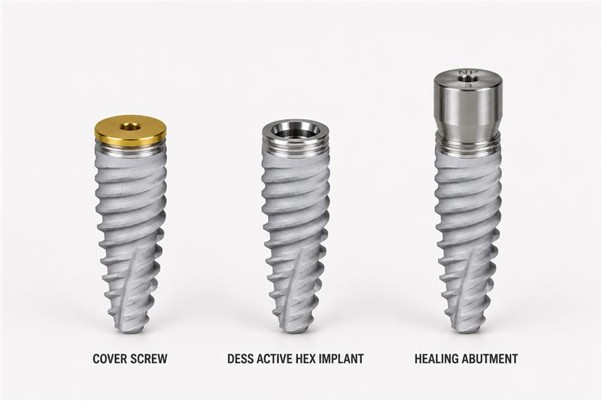
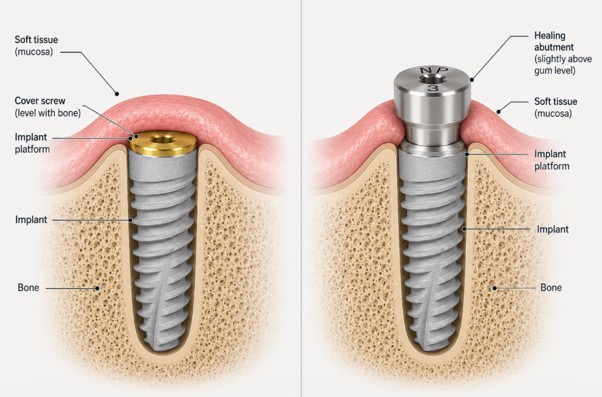
The most fundamental difference in the cover screw vs healing abutment comparison is exposure: a healing abutment emerges through the mucosa; a cover screw remains submerged beneath it. This single distinction shapes the entire healing trajectory.
A healing abutment supports immediate soft-tissue conditioning, allows easy access for the restorative team and removes the need for a second surgical procedure. A cover screw protects the implant connection during an undisturbed submerged healing period but requires a second-stage uncovering before soft-tissue shaping can begin.
There are also dimensional differences: cover screws are typically flat or domed and sit at or just above the implant platform, whereas healing abutments are taller and have a defined emergence profile. In every case, the component should match the chosen protocol, not the other way around.
One-stage vs two-stage implant protocols
Component choice is closely tied to whether a one-stage or two-stage surgical protocol is selected.
In a one-stage protocol, the implant is placed and a healing abutment is connected at the same surgical appointment. The soft tissue heals around the abutment, eliminating the need for a second surgery. This approach is generally favoured when primary stability is high, soft-tissue thickness is adequate, and the case allows for earlier soft-tissue conditioning.
In a two-stage protocol, the implant is placed with a cover screw and submerged beneath the soft tissue. After a defined healing period, the implant is uncovered and a healing abutment is placed. Two-stage protocols are often chosen when simultaneous bone grafting has been performed, when soft-tissue protection is required, or when uncontrolled loading must be avoided during osseointegration.
Neither protocol is inherently superior; the choice depends on bone quality, soft-tissue conditions, the surgical site and the planned restorative timeline.
Soft-tissue healing and emergence profile considerations
Healing abutments play a direct role in shaping the peri-implant soft tissue. The diameter, gingival height and emergence profile of the selected component define the soft-tissue cuff that the future restoration will inherit. A healing abutment that is too narrow may produce a soft-tissue collar that is difficult to support with the definitive crown; one that is too wide may cause blanching, recession or compression of the mucosa.
Cover screws do not influence soft-tissue contour directly because the tissue heals over them. However, the duration of submerged healing and the subsequent emergence of the healing abutment together determine how predictable the final emergence profile will be. Planning the transition between cover screw and healing abutment from the outset helps the restorative team anticipate how the soft tissue will respond.
Clinical factors that influence component selection
Several factors guide the decision between a healing abutment and a cover screw, including primary stability at the time of placement, soft-tissue thickness and biotype, the need for adjunctive procedures such as bone grafting, aesthetic demands, the planned restorative timeline, and patient-specific factors such as parafunction, hygiene capacity and systemic conditions.
Once the protocol is defined, the next step is to verify that the chosen component is compatible with the implant system, platform and connection. A healing component that is dimensionally close but not fully matched to the connection can produce micro-gaps, soft-tissue irritation or difficulties at the restorative stage.
How DESS® healing components support predictable workflows
Component selection is only one part of the decision, component compatibility is the other. Using the correct platform, connection and dimensional configuration is essential to ensure that the healing component seats fully and either protects the implant connection or shapes the soft tissue as intended.
DESS® offers a comprehensive range of DESS® Healing Abutments designed for multiple implant systems and platform dimensions, with gingival heights and emergence profiles suited to common clinical situations.
For submerged healing protocols, DESS® cover screws are available for both implant connections: cover screws for Conical BLT implants and cover screws for Active Hex implants, covering the connection geometries used across these implant ranges.
For multi-brand workflows, the DESS® catalogues and the DESS® implant brand compatibility resources help clinicians verify component selection before surgery, reducing the risk of platform mismatches or incompatible healing components. For all components, clinicians should follow the official IFUs and refer to the corresponding compatibility documentation when working across multiple implant systems.
FAQ
What is the difference between a healing abutment and a cover screw?
A healing abutment is a transmucosal component that emerges through the soft tissue and shapes the peri-implant mucosa during healing. A cover screw is a low-profile component that seals the implant connection during a submerged healing period and remains beneath the soft tissue until second-stage surgery.
When is a cover screw used?
A cover screw is used in two-stage protocols, where the implant heals submerged beneath the soft tissue. It is often selected when simultaneous bone grafting has been performed, when soft-tissue protection is required, or when uncontrolled loading must be avoided during osseointegration.
Are healing caps and healing abutments the same?
In most clinical contexts, the terms healing cap implant and dental implant healing cap refer to the same transmucosal component as a healing abutment. Terminology may vary by market and manufacturer, but functionally both terms describe the component used to shape the soft tissue during the transmucosal healing phase.
Can a cover screw be used in a one-stage protocol?
Not as the final healing component. In a one-stage protocol, a healing abutment is placed immediately after implant placement to allow transmucosal soft-tissue healing without a second surgery. A cover screw is specifically designed for submerged healing and is removed before the restorative phase begins.
Explore DESS® healing components for dental implant workflows →



Dra. Patricia Isaac is a dentist and specialist in Oral Rehabilitation at DESS® and is part of our technical support department. She assists and supports our customers with technical issues about products, dental implants and prosthetic abutments, among others.
-
Titanium in Implantology: A Scientific Perspective
 September 15, 2026
 -
Scan Bodies for Dental Implants: Common Errors That Affect Restoration Accuracy
 August 28, 2026
 -
Peri-Implant Soft Tissue and the Long-Term Success of Implant-Supported Restorations
August 21, 2026
-
Transepithelial abutments: DESS® solutions for screw-retained implant restorations
 July 29, 2026
 -
KOL Interview: Digital Workflows, Precision & Predictable Implant Restorations
 July 28, 2026